

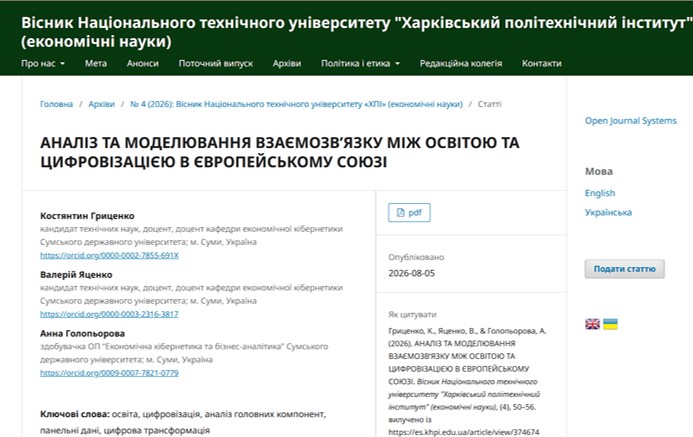
The researchers behind the Jean Monnet project “Development of Digital Competencies for Digital Economy Professionals and Business Leaders: Best European Practices for Ukraine” have published an article titled “Analysis and Modeling of the Relationship Between Education and Digitalization in the European Union” in the journal “Bulletin of the National Technical University ‘Kharkiv Polytechnic Institute’ (Economic Sciences).” This article is available at: https://es.khpi.edu.ua/article/view/374674/357875
This article examines the relationship between education and digitalization as interdependent components of contemporary socioeconomic development. The aim of this study is to assess the two-way influence of educational potential on the level of digitalization and of digitalization on the development of the educational sector, based on integrated indicators and methods of panel econometric modeling. The subject of the study is the processes of formation and development of education and digitalization, as well as the mechanisms of their mutual influence in the context of the digital transformation of the economy. The methodological framework of the study consists of methods for analyzing and synthesizing scientific sources, correlation analysis, principal component analysis (PCA), assessment of multicollinearity using the variance inflation factor (VIF), as well as panel data models with fixed and random effects. In the course of the study, integrated indicators of education and digitalization were developed based on a system of statistical indicators characterizing the level of the population’s digital skills, the training of ICT specialists, the development of digital infrastructure, and the use of digital technologies. It was found that the population’s ICT skills and the proportion of individuals with higher education in ICT fields have the most significant impact on the level of digitalization. At the same time, the modeling results confirmed that digitalization has a reciprocal impact on the education sector through the proliferation of digital services, the development of high-tech economic sectors, and the growing demand for skilled human capital. The findings indicate the existence of a strong two-way relationship between education and digitalization. Education fosters the competencies necessary for the implementation of digital technologies, while digitalization creates additional opportunities for modernizing the educational process and developing human capital. The study concludes that the comprehensive development of the educational system and the digital environment is essential as interrelated factors in ensuring sustainable economic growth and enhancing the country’s competitiveness. The practical significance of this study lies in the potential to use its findings to develop public policy in the areas of education, digital transformation, and the enhancement of the population’s digital competencies.